
The Next Edition
  • Home
  • About Us
  • News
  • Featured
  • Investigations
  • Foreign
  • Special Reports
  • Entertainment
  • Interviews
  • Advert Rate
No Result
View All Result
  • Home
  • About Us
  • News
  • Featured
  • Investigations
  • Foreign
  • Special Reports
  • Entertainment
  • Interviews
  • Advert Rate
No Result
View All Result
The Next Edition
No Result
View All Result
Home Headline News

NASA launches spacecraft to probe the Sun

Agency Report by Agency Report
August 11, 2018
in Headline News
0
NASA launches spacecraft to probe the Sun
0
SHARES
0
VIEWS
Share on FacebookShare on TwitterShare on Whatsapp

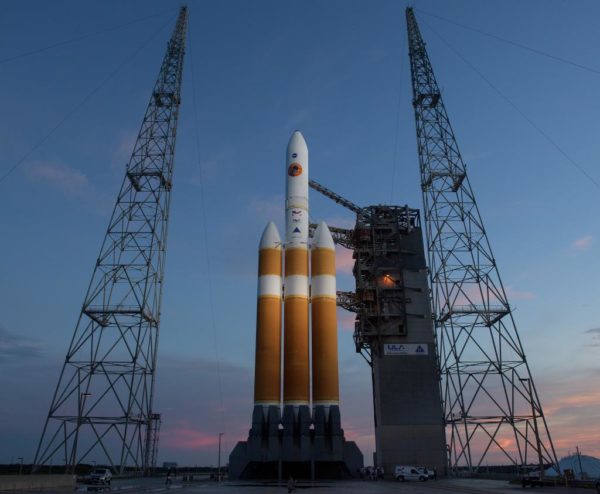
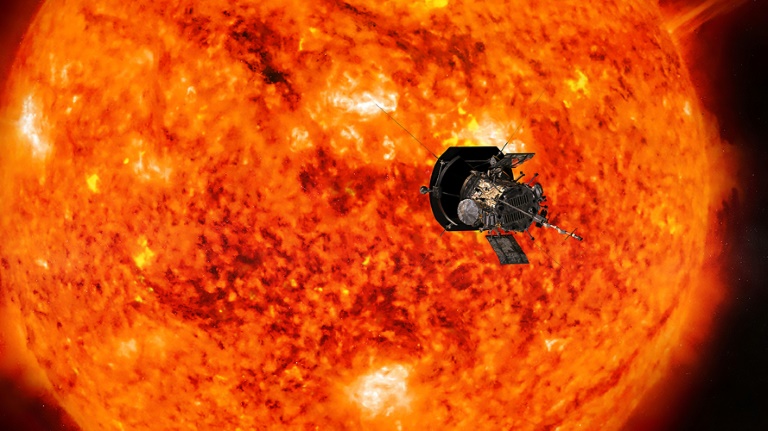
NASA will launch today a $1.5 billion Parker Solar Probe spacecraft that aims to plunge into the Sun’s sizzling atmosphere and become humanity’s first mission to explore a star.

The car-sized spacecraft is scheduled to blast off on a Delta IV Heavy rocket from Cape Canaveral, Florida early Saturday.
The 65-minute launch window opens at 3:53 am (0753 GMT), and the weather forecast is 70 per cent favourable for takeoff, NASA said.

The probe’s main goal is to unveil the secrets of the corona, the unusual atmosphere around Sun.

Not only is the corona about 300 times hotter than the Sun’s surface, it also hurls powerful plasma and energetic particles that can unleash geomagnetic space storms and disrupt Earth’s power grid.

“The Parker Solar Probe will help us do a much better job of predicting when a disturbance in the solar wind could hit Earth,” said Justin Kasper, one of the project scientists and a professor at the University of Michigan.

READ ALSO: NiMet predicts Thunderstorms, rains for Saturday

The probe is protected by an ultra-powerful heat shield that is just 4.5 inches thick (11.43 centimeters).

The shield should enable the spacecraft to survive its close shave with the centre of our solar system, coming within 3.83 million miles (6.16 million kilometers) of the Sun’s surface.

The heat shield is built to withstand radiation equivalent up to about 500 times the Sun’s radiation here on Earth.

Even in a region where temperatures can reach more than a million degrees Fahrenheit, the sunlight is expected to heat the shield to just around 2,500 degrees Fahrenheit (1,371 degrees Celsius).


Tags: aircraftGalaxiesMeteorologymoonNASAplanetSatelliteSpace programSun
Previous Post

BBNaija’s Alex Unusual offers eye surgeries to less-privileged

Next Post

Foreign Titbits: Chemical giant Monsanto to pay $289m damages in Roundup cancer trial

Next Post
Foreign Titbits:   Chemical giant Monsanto to pay $289m damages in Roundup cancer trial

Foreign Titbits: Chemical giant Monsanto to pay $289m damages in Roundup cancer trial


The Next Edition

Office Address

3B, Agboola Aina street, Off Toyin Street,
Ikeja, Lagos.

Quick Contact Details

Phone:
08057511685
Whatsapp:
08051679910

Email:
advert@nextedition.com.ng
vicki.ibanga@gmail.com

Categories

  • Aviation
  • Beauty
  • Breaking News
  • Business
  • Columnists
  • Editorial
  • Entertainment
  • Fashion
  • Featured
  • Football
  • Foreign
  • Headline News
  • Home & Garden
  • Interviews
  • Investigations
  • North Central
  • North East
  • North West
  • Opinion
  • Parenting
  • Politics
  • Relationships
  • South East
  • South West
  • South-South
  • Special Reports
  • Sports
  • Top News
  • Vox Pops

© Next Edition Business Development Limited

  • About Us
  • Advert Rate
  • Contact Us
  • Privacy Policy
  • Terms of Use
No Result
View All Result
  • Home
  • About Us
  • News
  • Featured
  • Investigations
  • Foreign
  • Special Reports
  • Entertainment
  • Interviews
  • Advert Rate

© Next Edition Business Development Limited