

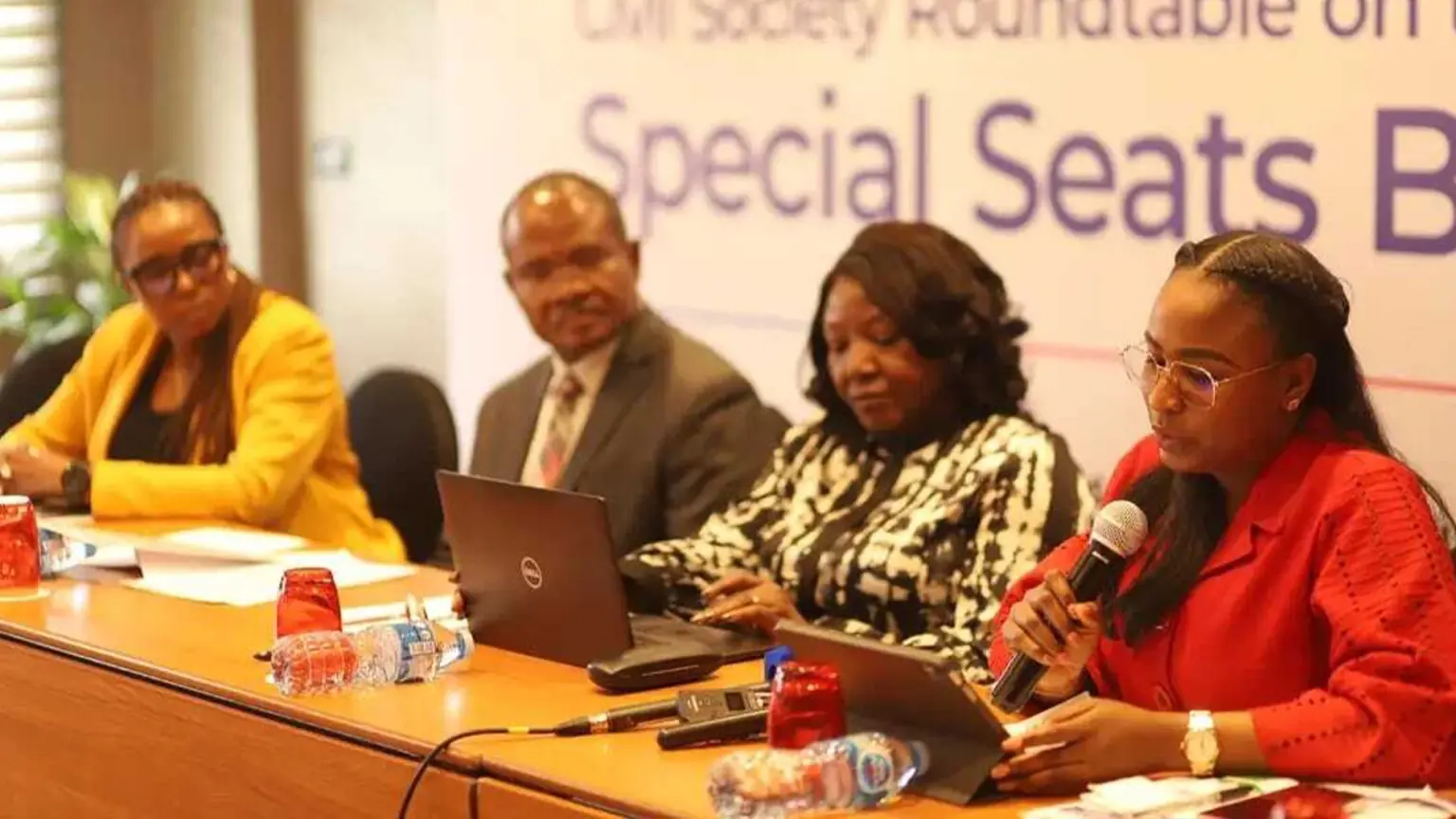
The Policy and Legal Advocacy Centre (PLAC), Civil Society Organisations (CSOs) and development partners have called for critical assessment of the National Assembly proposed Electoral College Model Means for electing women into special legislative seats.
The stakeholders made the call in Abuja on Friday during a high-level roundtable organised by PLAC with support from the European Union (EU).
This is ahead of the National Assembly Open Week on the ongoing Constitutional Amendment process.
The News Agency of Nigeria (NAN) reports that the NASS has proposed an Act to alter the 1999 Constitution to provide for additional special seats for women in the Senate, House of Representatives and State Houses of Assembly.
The aim is to provide for the filling of special seats through an Electoral College, using an Electoral College Model Means as a temporary special measure to increase the political representation of women in legislative institutions and for other related matters.
Mr Clement Nwankwo, the Executive Director of PLAC and Lead Technical Adviser to the House of Representatives Committee on Constitution Review, said the electoral college proposal emerged from consultations with lawmakers.
Nwankwo disclosed that some lawmakers had expressed reservations over direct elections for the additional seats leading to the proposed electoral college model means.
According to him, the revised proposal is designed to retain the objective of increasing women’s representation while improving the bill’s chances of securing legislative approval.
“The proposal is unfamiliar to many stakeholders and understandably raises concerns, but we must carefully interrogate it instead of dismissing it outright.
“Our responsibility is to identify possible loopholes and recommend safeguards that will strengthen the legislation and preserve its democratic objective.
“If dominant political interests are allowed to control the process, the purpose of expanding women’s representation could be defeated before implementation even begins,” he said.
Nwankwo said concerns over the possibility of dominant political parties capturing the proposed Electoral College call for critically interrogation of the proposed model to ensure transparency, fairness and inclusiveness.
“If a geopolitical zone is largely controlled by one political party, you can already anticipate the likely outcome. Those are some of the issues we must interrogate as stakeholders,” he said.
He explained that women, under the proposal, would be nominated by political parties and elected by an Electoral College comprising governors, senators, members of the House of Representatives and elected local government officials from each geopolitical zone.
The PLAC executive director said that the constitutional amendment proposes 12 additional senate seats for women.
These, he said, comprise two seats from each geopolitical zone, 37 additional seats in the House of Representatives, including one for the Federal Capital Territory (FCT), and 108 additional seats across State Houses of Assembly.
He noted that the proposal also retains a 16-year sunset clause, making the arrangement temporary unless renewed through another constitutional amendment.
Prof. Antonia Okoosi-Simbine, the Director-General of the Nigerian Institute of Social and Economic Research (NISER), said Electoral College systems had successfully operated in several democracies, but that their credibility depended largely on institutional design.
“The composition of the Electoral College is the most important determinant of its credibility, transparency and public acceptance.
“Countries that have improved women’s political representation deliberately designed affirmative measures suited to their constitutional realities rather than adopting a one-size-fits-all approach.
“If Nigeria adopts this model, extensive civic education and strong legal safeguards will be essential to inspire public confidence and prevent abuse,” she said.
Okoosi-Simbine, also a former National Commissioner, Independent National Electoral Commission (INEC), cited Rwanda, Uganda, Morocco, Pakistan, India, Germany and the United States as some countries where different forms of indirect electoral systems had strengthened representation.
Ms Joy Akut, the Special Adviser to the Deputy Speaker on Youth and Women Affairs, said that the proposed amendment had not departed from its original objective of increasing women’s participation in governance.
According to her, what changed is the electoral mechanism and not the mission of expanding women’s representation in democratic institutions.
“Every electoral system presents certain challenges, but our collective responsibility is to ensure that whichever model is adopted delivers transparency, accountability and inclusion.
“Nigeria cannot continue excluding women from legislative decision-making while expecting stronger democratic outcomes and inclusive governance,” she said.
Akut urged stakeholders to focus on improving the proposed framework instead of allowing disagreements over the electoral college model to undermine the broader constitutional reform.
Ms Nakiri Sodi, the Programme Officer at PLAC, said the advocacy for increased women’s representation would continue throughout the constitutional amendment process and beyond.
“We are harmonising civil society positions ahead of the National Assembly Open Week to ensure lawmakers receive practical recommendations that will strengthen the bill.
“This advocacy has continued across successive assemblies because improving women’s representation requires persistence and sustained engagement.
“Our commitment is to ensure that the final legislation delivers meaningful inclusion rather than symbolic representation,” she said.
Mrs Mma Odi, the General Secretary of the Alliance for Credible Elections, urged stakeholders to carefully scrutinize the proposed model to avoid elite capture in the future.
Odi, however, called for focus on every mechanism capable of opening the political space for women and addressing the historical under-representation of women.
“What is important is opening the door for women to participate in governance.
“When women are at the decision-making table, they bring solutions to issues affecting families and society.
“The special seats will not stop women from contesting other elective positions; they will only help correct years of exclusion from democratic participation,” she said.
Representatives of other civil society organisations called for robust legal safeguards to prevent political godfathers, dominant political parties and influential office holders from controlling the nomination and election process under the proposed electoral college model.
They also stressed the need to ensure that women eventually elected through the special seats remained accountable to citizens rather than to members of the electoral college.
The stakeholders resolved to refine their recommendations, collate and present a harmonised advocacy position to the National Assembly as deliberations on the constitutional amendment and Women’s Special Seats Bill progressed.